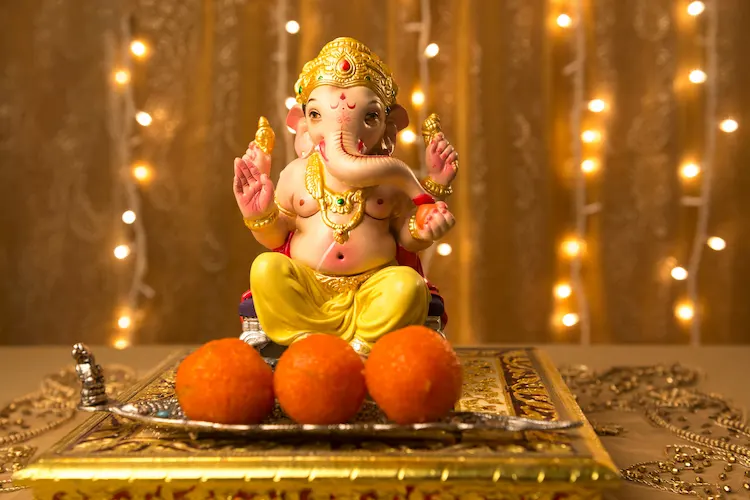
Ganesha is known as the “pratham pujya” (first-worshipped god) because he is worshipped before the worship of any god․ Other names of Ganesh are Ganpati, Ganesh, Ganesa, Vinayak, Gajanana, and Vighnaharta․ He is the supreme god. His devotees are not only Hindus but also Jains and Buddhists. His worship has spread all over India. He is also known as the remover of obstacles.
Divine History of Lord Ganesha
Mata Parvati is the mother of Ganesha and one of the principal Hindu goddesses․ She was at home and was going to have a bath․ Not wanting to be disturbed, she told Shiva’s bull Nandi, the guardian of the door, that no one should be admitted․ And Nandi is dutifully at his watch on the door․. But Shiva came, and Nandi, firstly being loyal to him, let him pass.
Firstly, she is angry with Nandi Shiva’s bull, but she realises she has no one loyal to her, as Nandi Shiva’s bull is loyal to Shiva. So she takes turmeric paste from her body, makes Ganesha with it, and tells him to be her loyal son the next day. When she has a wish to bathe, she gives the duty to Ganesha to protect the door.
Shiva came home, and an unknown boy (Ganesha) told him not to enter his own house. In anger, Shiva ordered his army to destroy the boy. But they failed because Ganesha possesses a different power. Shiva being surprised
Symbolism of Ganesha’s Form
Ganesha’s body has many symbols and meanings:
1- Elephant Head – It represents wisdom, intelligence, and understanding.
2-Big Ears – They show that we should listen more and talk less.
3-Small Eyes – They teach us to focus and concentrate.
4-Large Stomach – It shows that we should peacefully accept both good and bad in life.
During this festival:
People take the idols of Ganesha to their homes.
1-They decorate the idols with flowers and lights.
2-Divine History of Lord Ganesha
3-They provide sweets, especially modak (his favourite sweet)
4-After 10 days, Ganesha was submerged in water, which is called Visarjan
Ganesha as the God of Psychological Strength
Ganesha is the remover of outer obstacles, but spiritually, he represents the removal of inner obstacles. Inner obstacles like fear, confusion, ego, self-doubt, anger, and attachment. The elephant’s head symbolises intelligence. In real life, an elephant does not panic .he move continuously and powerfully. Ganesh teaches us that success comes from calm thinking, not from emotions
Ganesha’s broken tusk also has a meaning. He broke his tusk to continue writing the Mahabharat because his pen is broked .broken tusk show sacrifice and dedication to duty. It tells us that sometimes we must break a part of our comfort zone to do something great. This makes Ganesh not just a religious figure but a symbol of discipline and emotional balance.
The Deeper Meaning of His Family Position
Ganesha is the son of Shiva and the Goddess Parvati and the brother of the deity Kartikeya, the god of war․ He symbolizes speed and physical strength, while Ganesha symbolizes intelligence and strategy. One famous story of Karttikeya and Ganesh is circling the world. Kartikeya immediately left on his peacock to fly around the world. But Ganesha simply walked around his parents and said, “My parents are my world.” Because of his intelligence, he won.
The Eight Forms of Ganesha
Eight ancient temples in Maharashtra are recognized as Ashta Vinayaka temples (The Eight Ganeshas), each named after and featuring a legend relating to one of eight different forms of Ganesha․. These forms show Ganesha has many personalities. In some form, he is childlike; in another form, he is powerful and gentle. This idea teaches that intelligence has many forms. Sometimes it is soft and patient, and sometimes it must be strong and protective. Ganesha is a complete spiritual personality
Final words
Ganesh is one of the most important and beloved gods in Hinduism. His unique birth story and wise actions make him special. He represents intelligence, success, patience, and positivity. That is why he is invoked at the beginning of all new endeavors․ The stories and history of Ganesha act as a guide for understanding life․ A follower of his would also have a peaceful and successful life․
for more such information, visit the site historyoflords.com
FAQs
Q: Who is Ganesha’s wife?
Ganesha married two wives, Riddhi and Siddhi. Riddhi represents prosperity, and Siddhi represents spiritual power
Q: Does Ganesha have a son?
Yes, it is said that Lord Ganesha has two sons, Shubh and Labh. Shubh is the son of Sidhi, and Labh is the son of Ridhi. It is also said in some stories that he has a daughter named Santoshi.
Q: Which flower is not offered to Lord Ganesh?
Tulsi is not offered to Ganesha. She was impressed and wished to marry him. But Ganesh refused her proposal because he wanted to remain focused on his spiritual path.